

Welcome to the Brain Retraining Journal, my new Substack newsletter featuring a collection of insights, observations and practical tips from my experience healing using brain retraining and neuroplasticity.
So many of you have been reaching out asking about this and I realised, to my surprise, that I hadn’t written about it yet. Consider this long overdue.
Unfortunately, part of healing nervous system dysregulation inevitably involves patches where symptoms and sensations will intensify. Recovery isn’t linear and it is very common for things to ebb and flow. I truly believe that learning how to navigate through these ebbs, to become truly indifferent to a flare in symptoms, is probably one of the most important things that can aid recovery.
When symptoms flare, this is just the nervous system telling you it doesn’t feel safe. It is SO hard to believe this when you first start brain retraining and you aren’t yet convinced that nervous system work will help you. But if anything, random unpredictable flares became more evidence to me that my brain was misfiring. Why did I have symptoms at times I could never tie to a change in medication or supplements? Why would I spend weeks in bed after overdoing things and at other times be completely fine? That unpredictability to me was a sign that the nervous system was in play.
When this happens we have two choices. We can stress, ruminate and wonder what is going wrong, reinforcing these pathways and contributing to the continuation of the vicious cycle. Or we can learn to respond with indifference, recognising that our nervous system is feeling unsettled and using our tools to send messages of safety. I see it as a game. The higher level prefrontal cortex, our thinking brain, needs to rise above that stressed, fearful voice of the limbic system.
The first step is understanding this is the brain. The second is finding ways to respond. Yes we can use tools like visualisations, breathwork and others taught by programs such as DNRS and Primal Trust, and double down on them, but I think the underlying mindset needs to shift for true change. Here are some tips that have worked for me:
Don’t talk about it. Don’t reinforce the idea of a ‘dip’. Don’t complain and tell everyone you are in a ‘setback’. Language really matters. For the purposes of this post I am using the word dip, but when I have experienced an increase in sensations I try not to use the word at all. Someone once told me they call it a meadow, a little pause in the forest with sun shining through. Side note: the word meadow always reminds me of that scene in Twilight where Edward is glittering in the sun. Ok, now instead of using the word dip you can think of that and laugh at how silly it is. See how easy it can be to change our association, changing your relationship to the experience is key.

My favourite unintentionally funny movie Frustration is one of the biggest emotions that comes up during these times. I used to pause, validate that feeling then remind myself of higher emotions I could move towards. My inner voice would sound something like this: “Oh Alex, of course you are frustrated, anyone would feel frustrated. But is there a higher emotion we can move towards that is going to serve you better right now? Is this frustration helping your nervous system?”. Perhaps at times you may need to journal and really let that frustration out, but then start to notice where you are attaching a story to the frustration or ruminating on it. Thoughts such as, “this always happens. I’m always sick. Not again, my body can’t do anything”. Gently notice these, validate them, then redirect.
I would also tell myself I had the choice to sit and wallow in frustration feeling sorry for myself, or to surrender and rise above. Some days frustration and wallowing did win, but more often than not I was able to accept where my nervous system was at and move into a higher state. Logically we know that the second option is the better long term choice, it just takes a bit more motivation. With both options it might not change my immediate symptoms, however, being with them with a better mindset is also a better overall experience.
Really become aware of the thought patterns that come up. Recognise that your brain is in a stress state and is seeing the world through the lens of unsafety. The brain will start to tell you that brain retraining doesn’t work and that you can’t heal and many other wild stories! When you notice that, try to laugh it off. That is just your limbic system talking. Really try to become that higher-level observer of what is happening, watch your thoughts with detachment and try not to get pulled into them. This is your brain trying to keep you in the stress response.
See each meadow as an opportunity to practice your tools, aim to do just a little bit better each time. You’re not going to become perfectly neutral to these sensations right away. As a woman, I used to have very challenging periods once a month. Because I knew these were coming I started to see them as an opportunity to practice staying in a higher state. During the weeks before I would write a script to read to myself during that time, something like: “You are chipping away at this every day, becoming more experienced at understanding your nervous system and how to surrender. The limbic system is learning that you are safe. This is a new opportunity to teach the body to heal.” I know others who like to have voice recordings of visualisations ready.
Stop and feel your body. Am I tensing up? Are my shoulders relaxed? Is my jaw tight? I really love this ‘allowing’ meditation for tapping into a feeling of surrender and ease.
Remind yourself that you are safe. The nervous system is responding to a trigger that it doesn’t need to respond to. Use this moment to teach it that these triggers are completely safe. I remind myself, the more I can relax into sensations when they arise, the more I am teaching my brain safety and the less reactive it will be in future.
Something shifted for me when I realised I had taught myself to become indifferent to dips but there was still a part of me thinking “next time a dip comes I’ll know exactly what to do.” Then I realised I needed to change that narrative to, “I don’t have dips anymore. They are not part of my existence.” That is what I tell myself now. I had a virus recently and rested for a week or two after, but that was just what any person would do after a rough virus. Nothing more than that.

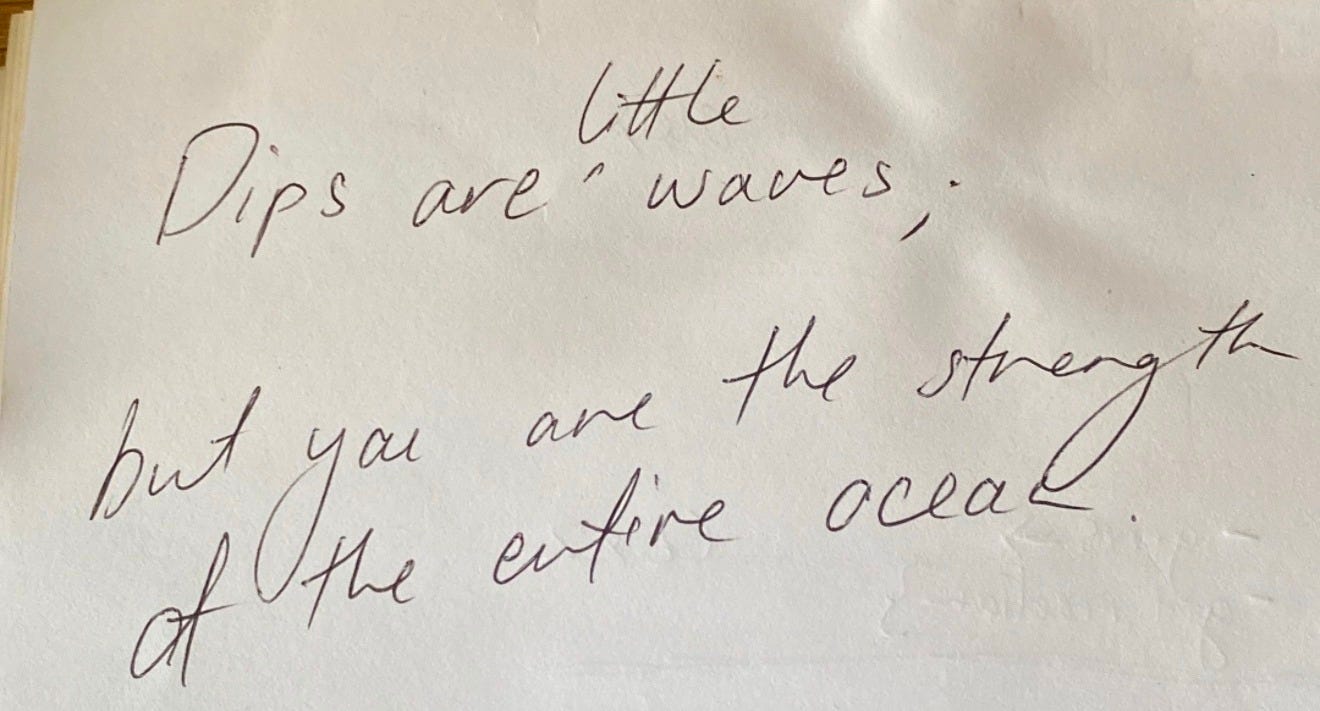
I do use this time to prioritise my tools, such as meditation, DNRS rounds or even listening to a Primal Trust Brain Attunement on repeat. However, it’s important to approach this with ease. Not in a “OMG, I NEED MY TOOLS MY NERVOUS SYSTEM IS STRESSED, let’s do two hours of rounds” way (guilty!), but in an “ok, what tool can I use right now to send love and support to my body.”
Oftentimes, these patches do involve the need to reduce activity. This is difficult because we don’t want to pull back out of fear of symptoms and reinforce any loops in our mind that are linking an activity or a trigger to symptoms, but we also need to recognise where our nervous system is at. For me when I pull back on activity I do it with love for my body. Because I love my body I am honouring where it’s at, but I know that those triggers are not the issue. My nervous system just needs a little bit more love at the moment. The way we speak to ourselves through this is important. We want to minimise fear and not reinforce any connections to triggers. You are not in the meadow because you ate something, moved too much or overdid a treatment, it’s just the nervous system recalibrating and rebuilding capacity.
I hope this collection of tips helps. I have a feeling this could become a series! There are so many different ways to approach it. I'd love to know what works for you, drop it in the comments.
Ps - I love hearing from you! It motivates me to write and gives me more ideas on what to share. Please don’t hesitate to reach out. Thank you to Lola who inspired this post
Note: My blog may contain some affiliate links. I will be paid a commission if you use this link to make a purchase at no extra cost to you. I only link to products or programs I have personally used
Such a good article, thank you. So glad I found your Substack! 💚 the waves quote is perfect, and love meadows as a reframe
Thank you for simplifying this process. It’s easy to over complicate and get confused in those liminal moments of retraining opportunity. I really appreciate the inner dialogue examples. ☺️🙏🏽